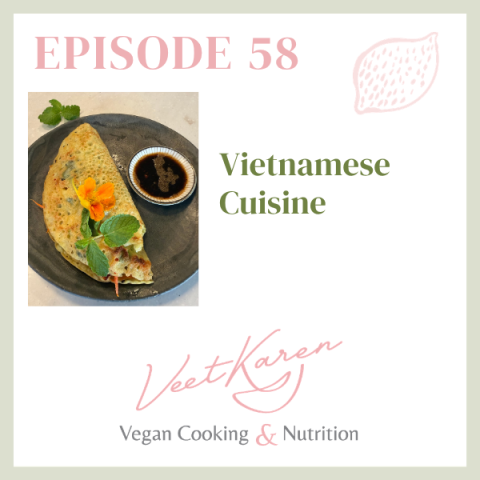
Episode 58
Vietnamese Vegan Food
Get ready to take your taste buds on a little trip to Vietnam, I am talking all things Vietnamese food.
Fresh herbs, crunchy vegetables, fragrant spices, rice noodles, tofu, chilli, lime and those incredible layers of sweet, salty, sour and savoury flavours. Vietnamese food is naturally full of everything that makes plant-based cooking so exciting.
And the best part? You absolutely don’t need meat or fish to create food that is colourful, satisfying and bursting with flavour.
So whether you’re already vegan, trying to eat more plants, or simply looking for delicious new ways to cook vegetables, today’s episode is going to give you plenty of inspiration.
Let’s get into the fresh, fragrant and seriously delicious world of Vietnamese vegan food!



Listen Now
Show Notes and Links
For more information on the Living well with Veet Online cooking and nutrition collective
https://www.veets.com.au/living-well-with-veet
Introduction
When asking people what they wanted me to talk about on my podcast a few people asked for Vietnamese food.
Here I finally am talking all things Vietnamese cuisine. Can you believe it, I have never been there. So I am only making Vietnamese food from what I have learned here in Australia.
I grew up next door to a gorgeous Vietnamese family in Darwin. They were a beautiful family and were renting a home that had a swimming pool which they were not familiar with in maintaining, so my mum would go and help them sort it out. They would give my mum the most incredible greens that they grew in return for her neighbourly spirit. They grew them in an old bath tub outside and I was fascinated by what and how they were growing their vegetables.
They had Kang kung or Rau muống (water spinach / morning glory) in the bath tub. It has become one of my favourite vegetables. I grew it for a few years, it is a perennial and lasts about 7 years.
Health Benefits of Rau muong
- High in vitamin A supports eye health and immune function, from beta-carotene content
- Good source of vitamin C antioxidant support, immune health, collagen production
- Iron-rich one of the better plant sources of iron, useful for preventing anaemia
- Calcium content contributes to bone health, notable for a leafy green
- High fibre supports digestion and gut health
- Low calorie, nutrient-dense very few calories per serving relative to the vitamins/minerals it offers
- Antioxidant compounds contains flavonoids and polyphenols linked to reducing oxidative stress
- Folate supports cell growth and is important during pregnancy
- Potassium helps regulate blood pressure and fluid balance
Even though I have never been to Vietnam this is how I think of Vietnamese food and some of this has been influenced by the beautiful Vietnamese community that lived in Darwin when I was growing up.
Vietnamese cuisine is a balance written in flavour
the sour bite of tamarind chasing
the sweetness of caramelised fish sauce, vegan of course,
the cool hush of mint and basil
laid over the heat of chilli,
broth simmered slow enough to hold the
memory of lemon grass and star anise in every spoonful
It's a cuisine of contrast and harmony in the same deep bowl
crisp against soft,
hot against cold,
herb against cinder
each bowl a quiet negotiation between north and south,
mountain and river, old empire and new street corner.
There is a
Balance of yin-yang of sour/sweet/salty/spicy/herbal in nearly every dish.
Freshness raw herbs and raw crisp veg piled on top of cooked elements, contrast of temperature and texture.
History in a bowl French invasion Chinese influence, and indigenous Southeast Asian ingredients layered together.
Street and ritual or in my case Hearn Court ritual where our neighbours ate – food eaten on low plastic stools or crouched down in a position my hamstrings can only dream of, communal, fast-paced yet deeply meditative.
Some Classic Vietnamese Dishes which are often pig, fish and cow heavy but can easily be veganised are here
Vegan Equivalents
Here are the vegan Vietnamese dishes described as their own thing:
Vegan Vietnamese Dishes
- Phở chay. A fragrant noodle soup with a broth, built from charred onion, ginger, shiitake mushrooms, daikon and roasted spices like star anise and cinnamon, simmered slowly for deep umami flavour. Served with rice noodles, tofu or seitan, fresh herbs, bean sprouts, and lime.
- Bún chả chay. Smoky grilled king oyster mushrooms or marinated tofu, served over a bed of rice vermicelli with a sweet-tangy dipping sauce, fresh lettuce, mint, and cilantro.
- Gỏi cuốn chay. Translucent rice paper rolls packed with tofu, crunchy vegetables, vermicelli noodles, and fresh herbs, dipped in a rich peanut sauce.
- Cơm tấm chay. Broken rice, served alongside grilled tofu or tempeh, tangy pickled carrots and daikon, and fresh cucumber, finished with scallion oil.
It became a popular Southern Vietnamese staple partly out of practicality and economy, broken rice was cheaper and more available, especially historically among rice farmers and mills in the Mekong Delta.
Despite its humble origins, it's now a beloved dish in its own right, not seen as lesser, served with grilled tofu, pickled vegetables, and vegan fish sauce.
Broken rice cooks slightly faster than whole grains because the smaller pieces absorb water more quickly. It has a slightly softer, stickier texture once cooked compared to whole-grain rice. The shorter grain fragments also mean it can clump a bit more, which some people find comforting rather than a flaw.
- Bún bò Huế chay. A bold, spicy noodle soup with a lemongrass-chili broth, tofu or seitan, thick rice noodles, and fresh herbs, capturing the fiery intensity of the original Huế-style dish.
- Cao lầu chay. Central Vietnamese-style noodles with a light, savoury sauce, mushrooms, tofu, fresh greens, and crispy rice crackers on top.
- Cà phê sữa đá chay. Strong Vietnamese coffee, brewed through a small metal phin filter, poured over ice and sweetened with condensed oat or coconut milk for a creamy, bold finish.
- Chả lụa chay. A dense, savoury pork-style pâté, made from mushrooms, tofu, or seitan, seasoned and steamed in banana leaves, sliced thin for sandwiches or rice plates.
- Bánh flan chay. A silky coconut milk custard, set with agar agar, topped with caramel sauce, offering the same wobbly sweetness as the classic French-Vietnamese dessert.
- Bò kho chay. A hearty, fragrant stew of mushrooms or jackfruit simmered in a lemongrass, star anise, and chili-spiced broth, served with crusty bread or rice noodles.
- Bánh xèo chay. A crispy turmeric rice-flour crepe, filled with mushrooms, tofu, bean sprouts and herbs, dipped in a tangy nước chấm-style sauce.
- Bánh cuốn chay. Delicate steamed rice-flour rolls, filled with minced mushrooms and wood ear fungus, topped with crispy fried shallots.
- Bánh bèo chay. Small steamed rice cakes, topped with crispy fried shallots and fragrant scallion oil.
- Bánh khọt chay. Mini crispy coconut-rice pancakes, filled with mushrooms or sweet corn, cooked in a special molded pan until golden and crisp at the edges.
- Chả cá chay. Turmeric and dill-marinated tofu, pan-fried until fragrant, served over rice noodles with crushed peanuts and fresh herbs.
- Cà ri chay. Curry with lemon grass and south east Asian spices as well as sometimes dill and Indian curry powder
- Nem rán chay / Chả giò chay. Crispy fried spring rolls, filled with mushrooms, carrot, taro, and glass noodles, served with a sweet-tangy dipping sauce.
- Mì Quảng chay. Turmeric-tinted noodles from central Vietnam in a light, savoury tofu-mushroom broth, topped with crushed peanuts, herbs, and rice crackers.
- Hủ tiếu chay. A light vegetable-mushroom broth noodle soup, with tofu and mock meats, fresh herbs, and crispy shallots.
- Xôi. Sticky rice, steamed until glossy, topped with mung bean paste, fried shallots, or shredded coconut.
- Bò lá lốt chay. Savory seasoned mushroom or seitan mince, wrapped in fragrant betel leaf and grilled until fragrant and slightly charred.
- Canh chua chay. A sweet and sour soup with tamarind, pineapple, tomato, and herbs, featuring tofu or straw mushrooms.
- Chè. A sweet dessert soup or pudding made with beans, jelly, and coconut milk, served warm or over ice.
Pronunciation Guide (approximate English phonetics)
- Phở – "fuh" (rising tone, not "foe")
- Bún chả – "boon chah"
- Gỏi cuốn – "goy kwon"
- Cơm tấm – "kuhm tuhm"
- Bún bò Huế – "boon baw hway"
- Cao lầu – "cow lau" (like "cow" + "lau" rhymes with "how")
- Bánh mì – "bun mee" (not "banh me")
- Cà phê sữa đá – "kah fay soo-a dah"
- Chả lụa – "chah loo-ah"
- Bánh flan (kem flan) – "bun flan / kem flan"
- Bò kho – "baw kaw"
French Invasion Fusion Dishes
- Bánh mì the clearest fusion example: a French baguette (adapted to be lighter and airier) filled with Vietnamese ingredients like pâté, pickled daikon and carrot, cilantro, chili, and grilled meats.
- Cà phê sữa đá Vietnamese iced coffee, using French-introduced coffee beans brewed through a small metal phin filter, mixed with sweetened condensed milk.
- Phở itself has a disputed but often-cited link to French pot-au-feu (beef and bone broth) style, adapted with Vietnamese aromatics and rice noodles instead of bread.
- Chả lụa / pâté chaud Vietnamese pork pâté and puff pastry dishes borrowing French pastry techniques.
- Bánh flan (kem flan) Vietnamese take on French crème caramel, often served with condensed milk or coffee.
- Bò kho beef stew with a French-influenced technique but Vietnamese spicing (lemongrass, star anise, chili).
Why the Fusion Happened
- France occupied Vietnam (1887–1954) and introduced ingredients like baguettes, coffee, dairy, and pâté.
- Vietnamese cooks adapted these imports to local tastes, lighter bread, less butter/cream, more herbs, fish sauce, and chilli.
The result is a cuisine where French style often meets Southeast Asian flavour balance (sour, sweet, salty, spicy, herbal).
Common Herbs & Spices
Herbs (fresh, used generously)
- Thai basil (húng quế)
- Cilantro/coriander (ngò)
- Mint (húng lủi)
- Perilla/shiso leaf (tía tô)
- Vietnamese coriander/rau răm
- French influence is dill
Spices & Aromatics
- Star anise
- Cinnamon
- Lemongrass
- Ginger
- Garlic
- Fish sauce (nước mắm) – the backbone of savoury flavour, vegan version is fabulous
- Chili (fresh or as sauce)
- Black cardamom (in phở broth)
- Fried shallots
Recipe
Bun Chay salad
½ packet noodles cooked and cooled
2 cucumbers sliced or julienned
2 carrots grated
½ bunch coriander
½ cup mung beans shoots
½ cup peanuts
1 ½ tbsp rice vinegar
Juice 1 lime
8 dates
½ tsp chilli freshly chopped
2 tbsp water
2 tbsp fish sauce
1. In a blender blend the vinegar, lime juice, dates, chilli, water and fish sauce.
2. Place all the other ingredients in a bowl and mix in the dressing.
Fun Cooking Tip
Make your own fish sauce
¼ cup dried porcini (or dried shiitake) in ½ water
1tbsp miso
3 tbsp tamari
2 tsp plum vinegar (or rice vinegar)
1 nori sheet
8 capers chopped fine
Method
Soak the porcini overnight in 1/3 cup water.
Next day, place all the ingredients including the porcini in soaking water into the blender and blend until smooth.
If it doesn’t go completely smooth you can strain and just use the liquid.
In the Living well with Veet Cooking and Nutrition Collective we have the month of October as Vietnamese cooking.
If you are listening post October 2026 the recordings of these recipes will be in the portal.
To join the collective click here.
For more information on the Living well with Veet Online cooking and nutrition collective
https://www.veets.com.au/living-well-with-veet
Have a beautiful week and let me know what you would like me to talk about next.
With gratitude
Veet